

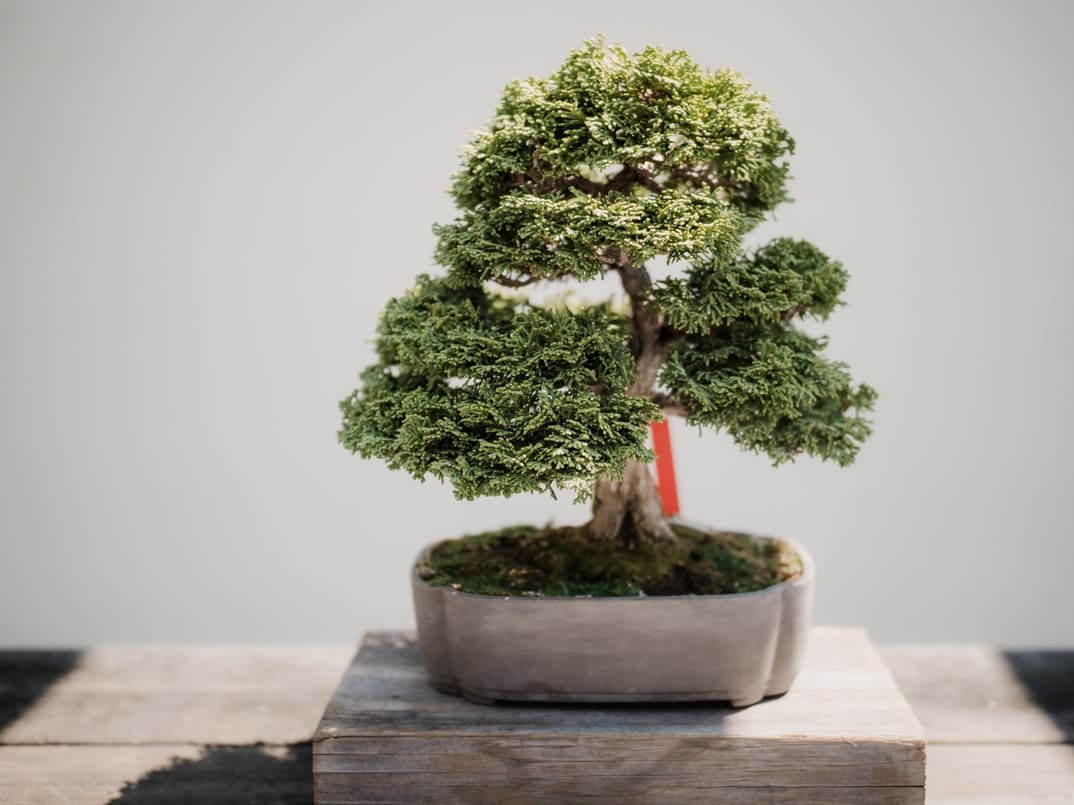

The pot your bonsai is planted in not only affects the drainage and health of your tree, but also its aesthetic look. Selecting the right bonsai pot for your tree is no easy task. Bonsai planters come in many different materials, colours, shapes and sizes. Although nowadays most pots are factory-made, you can also find unique handcrafted bonsai tree pots.
With such a wide variety to choose from, it can be quite overwhelming for bonsai enthusiasts to find the perfect pot for their beloved trees. To help you with choosing a bonsai pot, in this post, we’ll talk about the different aspects you should consider when thinking of repotting your bonsai into a new planter.
How to Determine the Ideal Size?
First and foremost, you have to consider what size pot you will need. If you’re unsure about the correct dimensions, there are some basic rules to calculate them according to the dimensions of your tree.
The general rule is that the depth of the pot should equal the diameter of the tree’s trunk just above the soil level. The diameter of the pot should be one-third of the height of your tree, for round pots. For rectangular or oval ones, the length of the pot should be equal to two-thirds the height of the tree.
If your tree has a particularly wide canopy, you might want to opt for a slightly shallower but wider pot. Likewise, for a tree with an especially thick trunk (in proportion to the height of the tree), a deeper but narrower pot might be more suitable.
These guidelines are valid only when it comes to the look of the tree. When it comes to botanical needs, it depends on the tree species most of the time. Different types of trees generally have different drainage needs. Some trees may require pots with faster drainage, while others like more moisture and need a pot which allows water to drain more slowly. Trees with faster-growing roots may often require a deeper pot, while some fruiting or flowering species might need more root run.
How to Choose the Correct Bonsai Pot Shape?
The style of the pot you choose for your bonsai will need to harmonise with the tree. To determine what shape of pot will suit your bonsai tree, you have to take a look at your tree and note its characteristics. Does your tree look more feminine or masculine? Most trees are a combination of both, although one side is usually more dominant. This subject can be abstract, because a tree may seem more masculine to some people and more feminine to others, so ultimately it’s a decision that depends entirely on you. You should note, though, that a thick and firm masculine tree won’t look right in a delicate oval pot, just as a smaller feminine tree will look awkward in a bulky rectangular pot.
What makes a tree look masculine or feminine?
A masculine bonsai gives the impression of strength. Typically, trees with a thicker trunk, uneven mature bark and strong angular branching are perceived to be more masculine. Masculine trees may also have deadwood, or a straighter trunk and a dense canopy.
Feminine trees, in contrast, will appear more delicate, with a smoother trunk and bark, more curves in the trunk and branches and a lighter foliage.
Some tree types are naturally perceived as more masculine or feminine. For instance, Pine or Podocarpus may often be considered more masculine, while delicate Azalea or Japanese maple will naturally be seen as more feminine.
Deep pots with angular features are considered masculine, while shallower pots with softer lines are feminine. Deep rectangular-shaped pots with sharp edges are typically suitable for masculine trees, just as square pots. Chunky oval pots and deeper round pots can be suitable for either type of tree. And finally, shallow oval or round pots with delicate edges are normally more suitable for feminine trees.
How to Match the Colour and Texture of the Pot to Your Tree?
Once you are set on a preferred size and shape, you have to think about the colour of your bonsai pot and the fine details, such as texture or pattern.
Although bonsais can be generalised into species, each tree is unique and slightly different from the other. Every bonsai tree has its own distinctive features, which can be brought out by choosing a pot with the right colour and texture.
You can choose the colour of the pot by picking up on a feature of the tree and accentuating it. For example, you can choose a colour that will complement that of the bark or leaves of your tree. For blooming or fruiting bonsai trees, you can also choose a pot which will bring out the colour of the flowers or berries.
The general rule is to select a colour and texture which will match the features of your bonsai, but in some cases, contrasting colours could work very well too, for example, putting a red-leaved tree in a blue pot to make the colour of the leaves stand out.
Textures can also be used to complement the characteristics of your bonsai. Pots with a smooth clay finish are more suitable for feminine trees, while heavily textured pots bring out the masculine features of a tree.
The colour and texture you choose will obviously depend on your tree and personal preferences, but you can also follow this basic guide to give you an idea of what colours complement different bonsai species:
- Off-white/Grey – Acer, Ash or Oak
- Oatmeal/Light brown – Elm, Acer, Larch, Ash, Beech
- Medium brown – Birch, Acer or Elm
- Dark brown/Red – Juniper, Larch, Pine, Azalea
- Light green – Beech, Ash or Acer
- Dark green – Chinese Elm, Acer or Azalea
- Light blue – Malu, Azalea and other flowering species
- Deep blue – Pine, Juniper, Acer, Azalea
To wrap it up, choosing a matching bonsai pot is a combination of personal taste as well as knowledge and experience. Make sure to take a note of the exact dimensions you need to avoid purchasing the perfect pot only to find it’s too big or small for your tree. Have an understanding of the shape which will complement the natural form of your tree, as well as the colour and texture you think will make your tree stand out.
If you have trouble deciding, don’t hesitate to ask for advice! The Bonsai 2 U team would be happy to assist you with any queries. Contact us if you need help choosing a pot for your bonsai or have any other questions. For advice on bonsai care, you can also check out our Care Hub and Blog.

